

Everything I am Preparing for my Self-Directed Research Project (+ Avoid the Rabbit Hole)
Building my own personal encyclopedia + Supplies & Preparation Process

See the previous article for the thorough background on the project’s scope, but to summarize: I am taking on a self-directed assignment to record, design, print, and bind my own encyclopedia collection of the history of humankind - as I’ve understood it.
The project is a culmination of my interests, curiosities, and hobbies wrapped and bound in one uniform display. At the core, the project allows me to refine my practice of learning in adulthood by offering longevity in its scope and breadth in its variety, while maintaining a linear path of education.
I have conducted many self-learning assignments throughout my adult life, all plucked from my orbit of curiosities and interests. This orbit seems limitless. I enjoy learning a wide range of subjects and that tends to feel a bit chaotic when narrowing my studies. The more I expose myself to, the more I understand how little I know, and how much there is to learn.
What a gift it is to realize that there will never be a point in which you have learned it all. How could you ever be bored, or uninspired? If at any point I am uninspired, it is clear I am too comfortable. The only place I ever want to feel comfortable, is out of my comfort zone. - My Inner Monologue
I will never learn it all, nor would I ever want to. But, I would like to bridge as many gaps in my knowledge as I am able.
The Problem:
Cannot Seem to Avoid the Rabbit Hole, Leading Away from the Intended Objective and Risking Abandonment of the Goal
In every single personal “curriculum” or self-study endeavor, I encounter the rabbit hole. A metaphor illustrated perfectly by Lewis Carroll in the 1865 Alice in Wonderland, where Alice spirals down a white rabbit’s dugout to an imaginative underground world, where one door (relentlessly) leads to another. Today, the rabbit hole symbolizes the act of being absorbed by a continuous chain of queries, leading you astray from the original starting point.
Questions are healthy. Questions inspire creativity and a motivation to learn.
“The answer it had provided me, like all good answers, only led to more fascinating questions. For me, answers were simply a way to get to the next question.”
- Matthew Walker PhD., Why We Sleep
Where questions become counterproductive is when they interrupt your train of thought, eject you from your flow state, distract you from your intended purpose for learning, and ultimately cause you to abandon your target and oftentimes leave you in a state of overwhelm.
Instead of securing a deeper understanding of a topic, you have accumulated a superficial and likely disjointed comprehension of many. At least from my personal experience.
The Cause: Gaping Holes in Knowledge Trigger Habit to Divert Attention to Missing Information
This happens exclusively when I allow the gaps in my knowledge to immediately dislodge me from my current assignment. The more gaps, the higher volume of diversions.
In my experience, the diversions are less about "new interests” or curiosities that snag my attention, but more “side quest” research to help me understand what it is I am learning. I feel that without it, I will not comprehend the information in front of me. Suddenly, I am 15 open tabs deep, my original textbook material shoved to the side, and somehow I landed on The Battle of Bunker Hill in my pursuit of answering some questions about the science of sleep.
My mind thrives off information inundation when it is cohesive and relative to the subject I am researching. It is here, where I often find myself in flow state. On the contrary, my mind withers at the flooding of information that infiltrates from all angles. Learning is certainly not linear, but erratic batches of information do not seem to yield a productive result.
The Solution: Create a Learning Curriculum that Allows for Gradual Accumulation of Knowledge to Minimize Need for Filling Information Gaps
Take any new skill…
Let’s use sewing as an example. You want to learn how to sew your own swimsuit.
You find a YouTube video tutorial on exactly that: How to Sew a Women’s Two-Piece Swimsuit. You buy the equipment and follow the tutorial as accurately as possible, without any foundational knowledge of skill acquisition.
The tutorial starts, you’ve purchased your fabric, and you begin by downloading the pattern provided. You’ve never seen a pattern before in your life, so the four solid lines, the dotted lines, the arrows, and the notes on the pattern are a foreign language.
Pause the video - you need to look up what the lines mean. Turns out, there are universally recognized notations on a pattern that help you understand how to use it properly. You figured out the lines indicate the sizing, the arrows indicate the grainline - wait.. what is grainline?
A new tab and a quick Google search explains that the grainline arrow indicating that I need to align the pattern parallel to the fabric’s selvedge edge… got it!
Wait. Google selvedge edge.
Now that you’ve decoded the pattern to the best of your abilities, you cut your fabric and proceed forward with the tutorial. Yes, a minor setback occurred when you had to figure out how to turn on, thread, and use the machine, but you’re back on track.
For demonstration purposes, let’s say you’ve managed to finish the tutorial and produce a garment. You slip it on and it stops abruptly at your thighs. How could this be? You measured accurately and followed the pattern sizing indications perfectly. Why doesn’t it fit?
Well, without a foundational understanding of fabric and its fibers, how textiles move and stretch, a well-executed pattern and YouTube tutorial may not yield the result you are hoping for. Is it a waste? Absolutely not. You learned to read a pattern, archived important terminology, threaded a sewing machine for the first time, and produced a garment - whether it is functional or not! Learning is critical and enriching no matter the method of execution. Learning is never a waste. My only observation is to highlight the unavoidable gaps in knowledge that appear in any learning endeavor. I believe the only instance in which gaps do not emerge, is when you have reached a level of mastery that only experts in their field can claim - and even then I think real masters of their craft never declare complete and total prowess.
In martial arts, the saying goes that, “a black belt is just a white belt that never quit.” The “experts” represent a return to foundational discipline and endless learning.
You may conclude that it is in your best interest to start at the beginning. To build a foundation that gradually acquires knowledge and information that compounds on the lessons before it, making it far less likely to divert from the process to plug the holes in your understanding.
The Solution: Start at the Beginning
And that is what led me to the personal encyclopedia project. To start at the beginning.
My desire to understand world history, politics, fashion, art, culture, and everything in between is seemingly endless. What better way to bring them all together than to embark on a quest to understand what it meant to be a human at any given time and place in our history.
This grants me access to a lifelong educational pursuit, which satisfies my number one goal: never stop learning.
It is not meant to be quick, it is meant to be slow and methodical. There is no race to the end. I hope to be in my nursing home one day still chipping away at the curriculum, if I am so blessed.
The hope and intent is for it to keep me motivated. Seeing a tangible exhibition of what I have learned would be deeply gratifying. If that isn’t enough to keep me going, knowing me, seeing one or two finished and bound volumes on my shelf will haunt me enough to keep from abandoning it.
Maybe I can pass them down to my family. Maybe my nephew will want Auntie’s weird books of knowledge that she may or may not have gotten right, but she damn well tried.
I realize starting at the beginning of humankind is extreme - but my ultimate point is if you are fighting to break the habit of rabbit-holing in your research, consider breaking down the curriculum more methodically and starting with a manageable baseline of foundational understanding, and building from there. You can apply this strategy on a much smaller scale than what I am proposing.
The Guardrails: Putting Systems in Place to Keep on Track
If we know up front that rabbit holes accompany self-directed learning, it would behoove us to put systems in place to help nudge us back on track throughout the learning process.
Here are a few of my guardrails based on my own observations:
Vocabulary
When confronted with any words/terms that need clarification:
Step 1: circle word in pen and continue reading passage until natural end
this prevents me from interrupting the flow of reading and thus risking comprehension of the overall idea being conveyed. Circling is a quick motion that can be done simultaneously to reading without much interruption. It is critical, in my opinion, to read until the “natural end” of the text. This could mean the end of the sentence, paragraph, page, etc. Often times, context clues both preceding and succeeding the word in question will help to define it.
Step 2: use context clues to make best estimate of the definition
this is a brain-game. I am often so far off-base of the actual definition that it makes me audibly laugh out loud, but the exercise is to challenge your brain into using context, whether it be from the text itself or drawn from any other outside source you may have archived in your memory to attempt to solve the puzzle without assistance. If you don’t like writing nonsense in your book, which definition attempts usually are, then consider using a sticky note or jotting down in a notebook.
Stop! INSERT GUARDRAIL:
The effort to define an unknown term stops at circling! If I am not able to define it using context at the end of the reading pattern, I move on and continue in my reading, writing, watching, listening, whatever task I intended to finish in front of me.
Instead, I have a system for undefined terminology that I deploy afterward:
Post-Study Session Vocabulary Dump
This is to be done outside of the study session. Sometimes I prefer to set aside 10 extra minutes after I am done studying to record vocab, or I will do it on a weekend when I am watching TV, I’ve even done it to pass time on the treadmill. To break a bad habit of checking my email or social media in the morning, I replaced it with a vocab dump.
The task is simply to record the word-definitions previously circled. I have a database in Notion that I store this in. I have previously shared my template with a detailed SOP and template. You can find the template here:
Now, as I am studying, I eliminate the pull to divert my attention to define unknown terminology because I know I have a system in place that will catch anything that falls through the cracks.
Curiosities
Without fail, something I read, see, or hear triggers my curiosity. It is a stray thought that catches my attention and entices me to explore it.
Curiosity is so important. I will die on the hill that returning to a childlike curiosity in adulthood will change your life. I refuse to suppress the stray thoughts for the sake of holding attention to what is in front of me. Far too many times have great ideas been forgotten if not captured when presented.
Instead, I have implemented a "stray thoughts catch-all” system that lets me have my cake and eat it too.
Personally, I have a handful of catchers that I routinely compile at the end of the week (end of month at the very latest), to implement action.
I prep the books I am reading with a sticky note in the front cover - this sticky note is peppered with stray thoughts that occur while I am reading any book
I have a mini moleskin notebook that I carry with me any time I leave the house. It is my stray thought catcher on the go.
I have a notebook at my desk
At the end of the week as part of my weekly prep routine, I have a checklist item that prompts me to gather my stray thoughts and enter them in their appropriate queues. I also have a checklist item in my Monthly Closeout routine that prompts the same. There are several safety nets for my inspiration and ideas so that they don’t fall through the cracks.
If this sounds like too much too fast, I highly suggest just implementing the sticky-note strategy while you are reading. If you are afraid you will never remember to revisit the sticky-note, take the opportunity right this moment to set a repeating alarm at the end of the week (or a time thats conducive to your personal lifestyle) that alerts you to revisit your sticky-note.
If you would like some insight with what to do with the stray thoughts after they’re captured, you can visit the following article:

Knowledge Gaps
The last big interrupter to tackle is gaps in knowledge. This occurs when an event, person, place, thing, theme, concept, etc. is introduced in the material that I am studying that I do not know or understand, compelling me to pivot to another tab or search in hopes of bridging the gap.
This is where developing an annotation strategy is most effective. I get asked all of the time “how to annotate.” I hesitate to share my system because I believe it should be customized to the person and the intent for annotating. One size doesn’t necessarily fit all. Instead, I would prefer to outline the problems I try to solve with annotating so you can use it as a framework to develop a method of your own.
Annotating is simply taking notes within the material you are reading. Marking it up with your pen (or digital pen if you do it on screen).
There is no right way to annotate text. The point is to convert the “passive reading” experience into an active one. Interacting directly with the words on the page - whether that be having a conversation with the author, making explanatory remarks, indicating key phrases, or general commentary. The sky is the limit. Draw a picture in the margins if you feel so inclined.
Before you devise your master annotating plan, consider the following:
What is the purpose for reading this text
Really make an effort to understand why you are reading it. This will help you determine what to actively look for in the text, and in turn, that indicates what sort of notes you should anticipate making
Once you understand what you hope to gain by reading the text, decide how you are going to alert yourself within the pages of any information or content that matters. Will you underline? Highlight? Both? What is the difference between an underline or highlight for you? How will you easily and quickly decide which to do while you are reading?
If I could bestow any wisdom upon you: do not overcomplicate it. Complexity will deter you. I learned the hard way after countless nights laying in bed wanting to pick up my book and picking up my phone instead because I couldn't deal with having to bust out a box of multi-colored highlighters and following an annotation key while laying horizontally.
Unfortunately, many opportunities to lose myself in a good book were robbed by screen time by a barrier to entry that I built myself.
How to Annotate Text:
Decide the following:
what tool(s) will I use that makes the most sense and maintain simplicity
what mark will I make for words I do not know the definition for
what mark will I make when there is a quote that resonates with me
what mark will I make when there’s data, supporting evidence, or information that pertains to my purpose for reading
what mark will I make if something sparks curiosity, inspiration, or commentary that intrigues me
My Personal Strategy:
what tool(s) will I use that makes the most sense and maintain simplicity
a clicky pen (I prefer clicky so that I can use with one hand, I have found that taking a cap off every time I want to use it drives me nuts)
a grey highlighter (I prefer grey because it is enough to bolden the text, but subtle enough that it fades into the page without creating a jarring distraction with a bright hued highlighter color. I only use one color highlighter. I have not found a necessity for differentiating the types of highlights with different colors, and I eliminate the need for extra supplies that need to be in reach to read, and also eliminate the decision fatigue with having to choose which is the right color to use.)
a sticky-note (Per the earlier mention, this one sticky-note sits in the front cover of my book to catch stray thoughts for later exploration that do not pertain to the text itself.)
tabs (I do tab the pages that I annotate so that it is easier to find my annotations later. However, I do not color code the tabs, I try to keep them a muted color like grey, and I place a stack of the tabs in the front cover of the book so that it is always accessible. I do not tab the pages as I read them, I wait until the end of my reading session to quickly tab the pages with the notes. I like to eliminate the breaks in reading as much as possible.)
what mark will I make for words I do not know the definition for
I draw a quick circle (as mentioned earlier) with a pen for any words I do not know AND words that I like. Circles are for words. Quick and easy.
what mark will I make when there is a quote that resonates with me
a quote that speaks to me is the only time I bust out the highlighter. It indicates to me when I return to my notes or entering any of my marginalia into my knowledge vault, that the highlighted remarks are words I want to save and cite the author
what mark will I make when there’s data, supporting evidence, or information that pertains to my purpose for reading
a simple underline. These often span across larger amounts of text than a simple standout quote does, which is why I underline in pen. If I have to emphasize nearly half a page of supporting evidence, it would be excessive to use a highlighter. An underline is enough to mark the text as information to extract, but not bold enough to saturate the pages.
what mark will I make if something sparks curiosity, inspiration, or commentary that intrigues me
brackets [ ] surround anything beyond the three instances listed above have a couple brackets around the passages that are usually accompanied by commentary in the margins.
Real Life Example of My Annotation Strategy
Using the current anchor book for our research-driven book club, you can see the annotation strategy in practice.
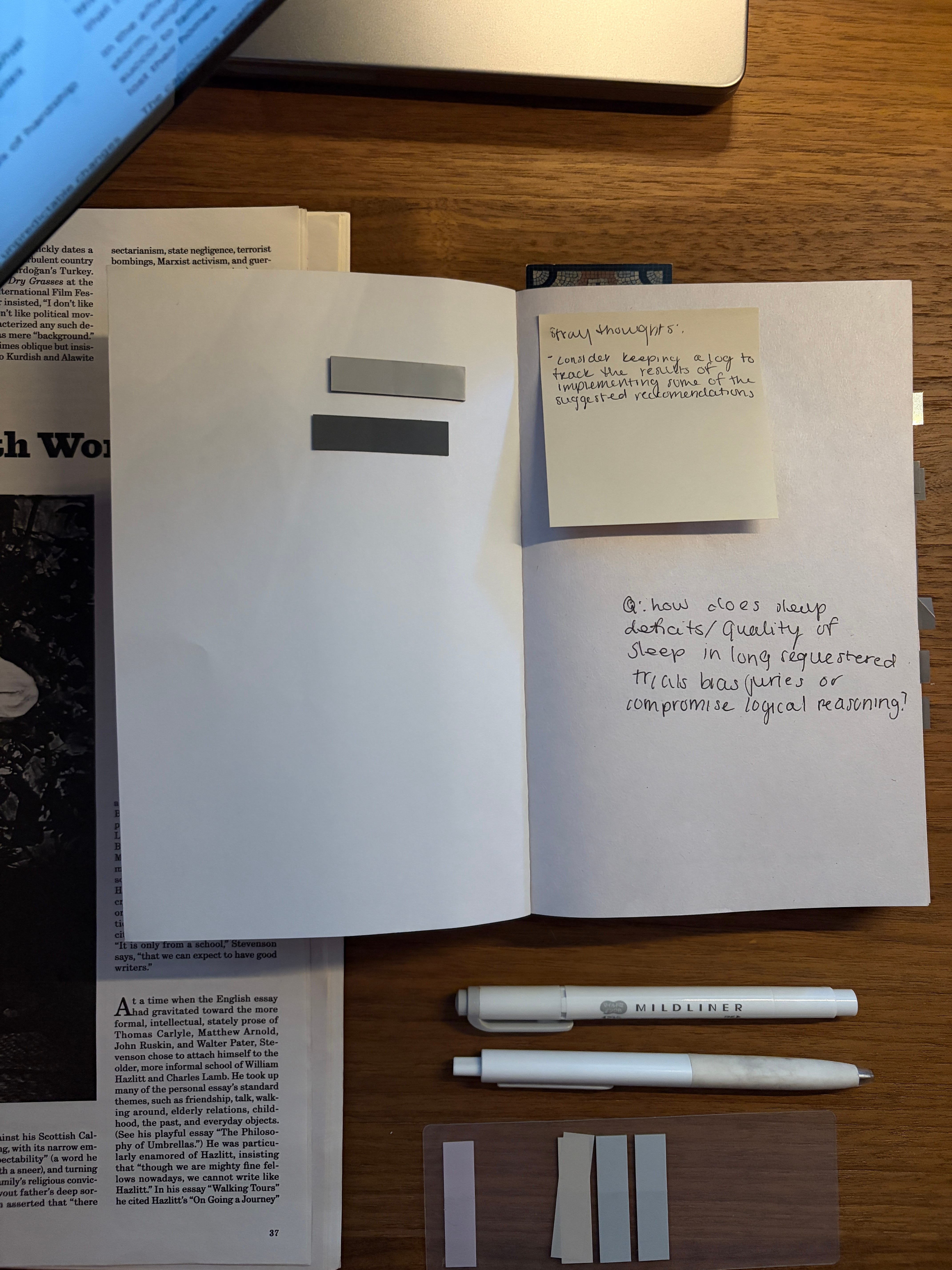
You’ll see on the inside front cover I have prepped my book with my must-haves: a sticky-note for stray thoughts, a set of tabs for easy access, and a written note containing the main purpose for reading.
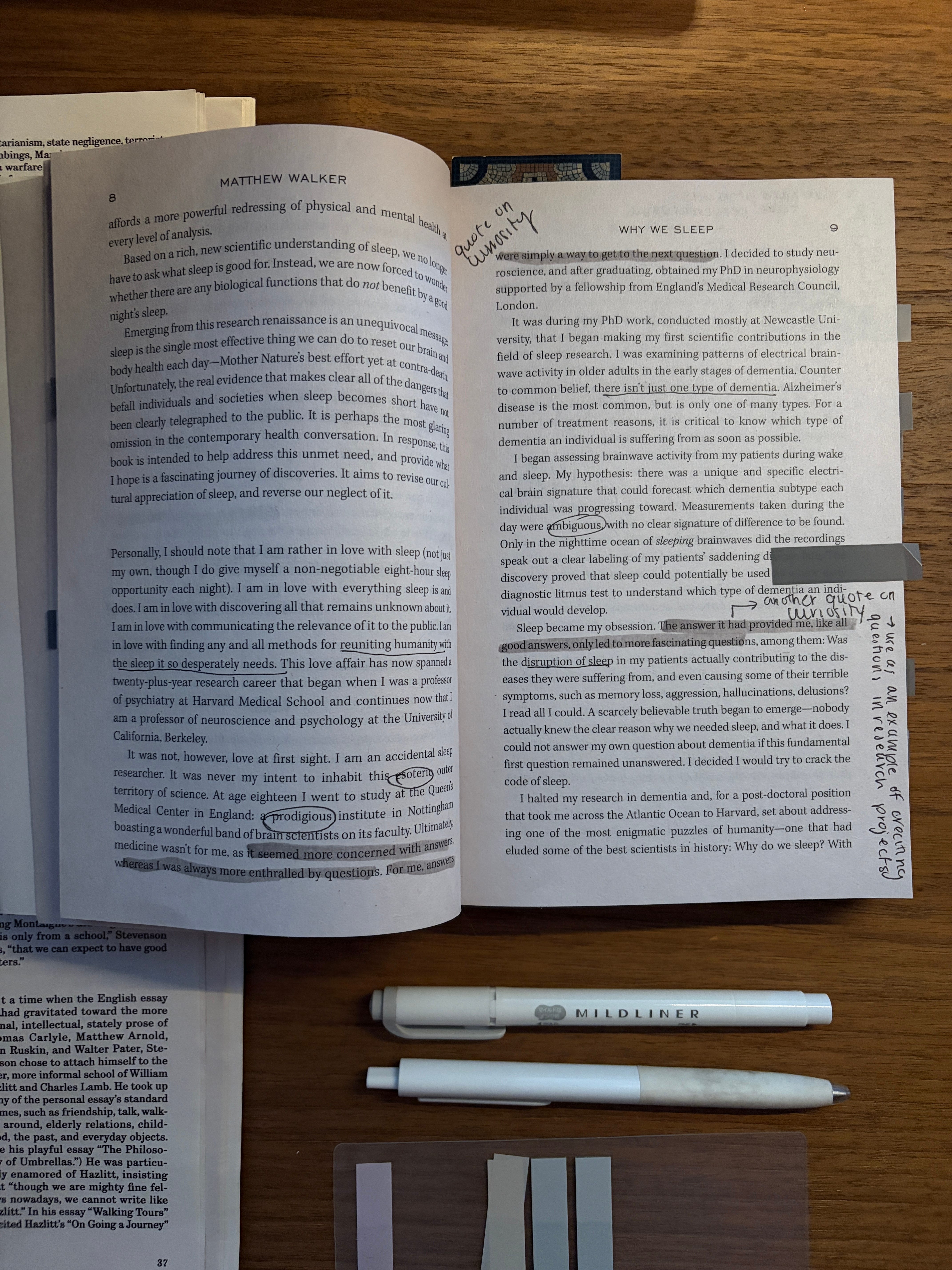
You’ll notice in the example above, I have circled several words that I either didn’t know the definition of, or words that I liked and want to save in my language and vocabulary database.
Information I found relevant to my purpose for reading the text has been underlined.
You may also find the highlighted quote familiar, as I used it in the beginning of the article to emphasize my point about the importance of asking questions for creativity and continuous learning.
My two favorite writing tools are pictured: the Mildliner in Grey by Japanese stationery brand ZEBRA. I buy the packs of 10 grey at a time + the Writech 0.5mm pen.
Preparing Notion & Obsidian for My Research Project
My tech stack power-house duo is Notion + Obsidian.
I use Notion exclusively to manage my life. It houses my tasks, goals, calendars, planning, and managing of every area of my life. It is my command center and has been for nearly a decade.
I use Obsidian to manage my knowledge. My entire publication here on Substack is an extensive explanation and use-case display of both applications, so if you are interested I think you’ll have a lot of great binge-able material to read on both here.
I am building the structure of my curriculum in Notion where I can efficiently track source material, build syllabi, and connect my project timeline to my existing calendars like I would a traditional university or online course. Notion manages the logistics of the project.
Obsidian is where the learning takes place. As with the rest of my knowledge and information accumulation, Obsidian will be the home of all note-taking, source material, essays, etc. I am utilizing the Canvas feature of Obsidian to build a visual of the historical timeline so that I can move along a linear path.
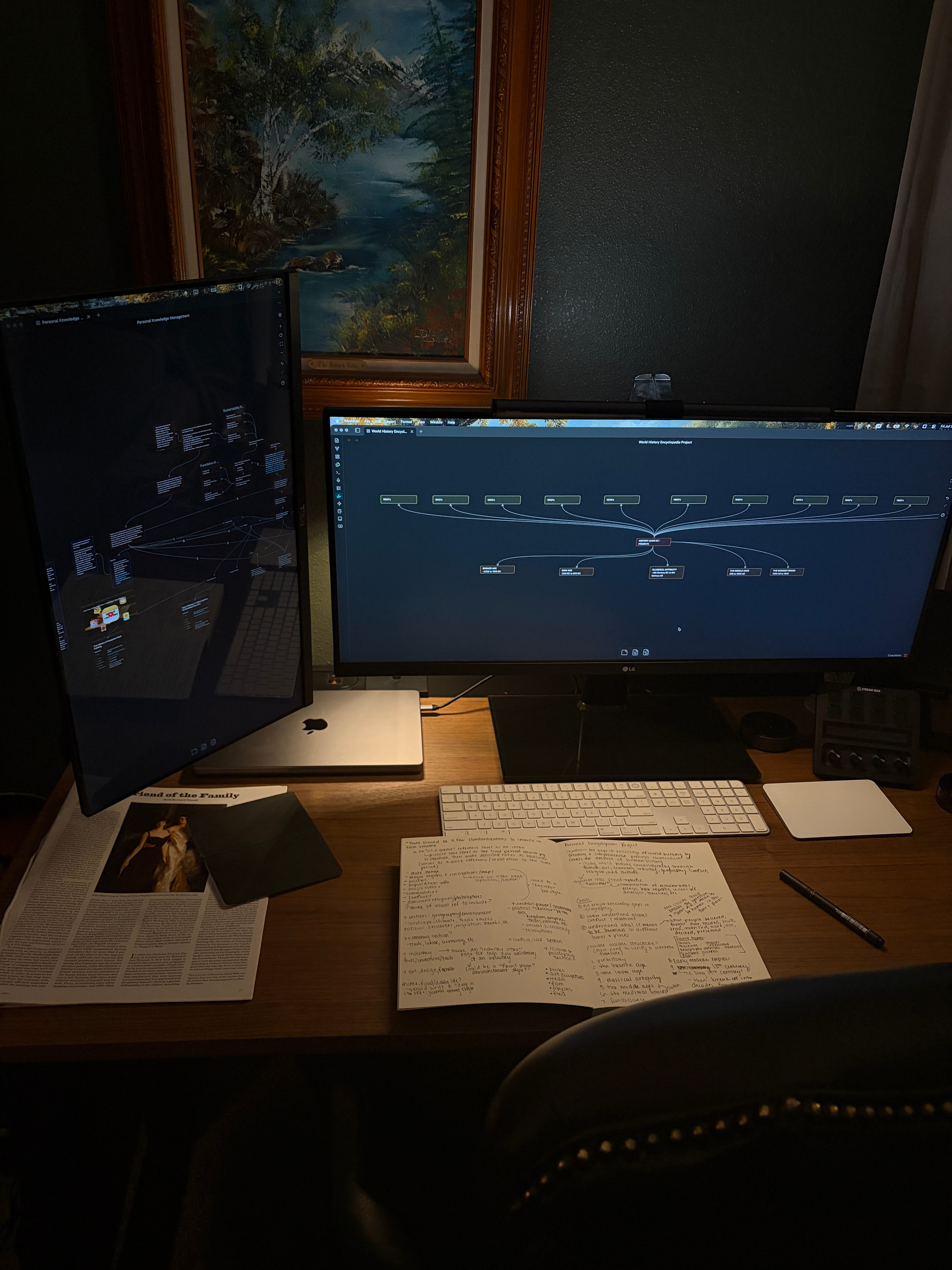
Encyclopedia Format Research
I have been hunting thrift stores and eBay for a collection of Encyclopedias to use as inspiration for the layouts, formatting, and structure of my own. I tried desperately to inherit my grandma’s, but my uncle beat me out, so I have to get scrappy.
Lo and behold, after visiting my local library’s monthly 50% off First Friday bookstore event this past week, there she stood. A 1964 World Book encyclopedia collection, A-Z. Every volume accounted for. $10.
It has been decades since I have thumbed through a physical encyclopedia. My next task is to sit on my floor among my new (old) collection and take note of the notable components and formats that make up an encyclopedia to include in my own. This inspiration will serve as a skeleton for turning my notes and research into finished works. Essays, maps, profiles, visuals, etc.
I am currently preparing the back-end of my Obsidian vault with templates that will make note-taking an easier process throughout the project. This includes a thorough book report template to use any time I finish a book, notable person’s profiles, event timelines, etc.
As I finish these templates I will share them for download here on Substack if you care to use them in your own vault.
Suffice it to say, I’ve got my work cut out for me. The prep is part of the fun, and there is a stack of vintage encyclopedias whispering in my ear to crack them open - so off I go!
Thanks for being here. I’ll keep you updated on the progress and resources I have to share along the way.
happy learning!
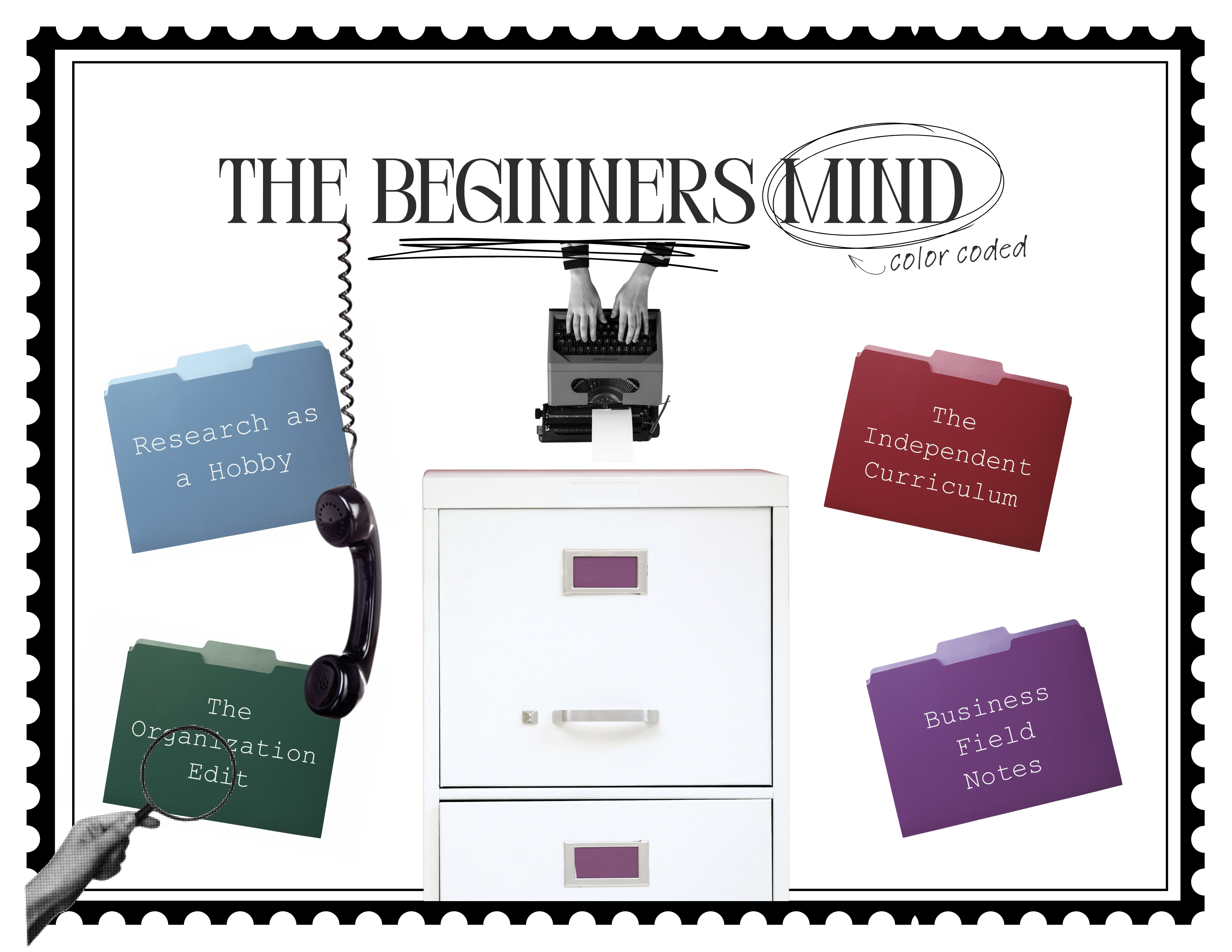
Thank you for reading The Independent Curriculum File! I am truly having the time of my life writing these.
As promised, the first published entry in each of The Files are available for Free. That is a total of 4 published articles so that you can get a solid idea of what is to come, and if you will find it valuable to add to your life before you subscribe as a paid reader.
As a reminder, the front pager articles will always be free. It is designed to read and present like a nostalgic newspaper, sprinkled with the previews, highlights, and valuable bits from the extended “Files” in my Substack Filing Cabinet. If you like what you see, you will find the archives and deep-dives of these topics in their corresponding files (at the top of the publication page) as a paid subscriber to support my time and effort in composing them.
Much love,
Flossy Fay.
Your mind is extraordinary. A large language model in the flesh. Keep doing what you love!
You’re such an inspiration! I’ve started a Substack because of you 💕