

How I Write a Research Paper (When No One Is Grading)
A self-directed learner's guide to writing papers for intellectual growth + a mini homework assignment

For the purposes of this article and this publication as a whole, a “research paper” relates to a piece of academic writing that investigates a specific question or problem using systematic research and evidence, then analyzes and interprets that evidence to make an argument or present findings.
I loved writing assignments in school. Pair them with a trifold poster board presentation and I was in academic heaven.
I had a process for writing all of my papers that started in middle school.
Read the prompt → Write a one pager on everything I currently know about the subject without any reading/research → Research → Write a (very rough) first draft → review the rubric and annotate draft accordingly → fill gaps in knowledge lead by rubric → Write second draft → repeat until final draft
I still repeat this process today for self-assigned writing endeavors.
If you are new to my publication, The Beginner’s Mind, consider reading the:

to understand the basis of why I choose to do this.
The following sections will outline my personal guide for writing papers (by choice). As I often have to reiterate, these papers are for personal growth and are not intended as a scholarly journals or professionally researched/published works. The purpose is simply to continue exercising cognitive muscles to reinforce learning and deepen my understanding of the ideas I’m exploring using tools accumulated from years in a formal classroom setting.
Disclaimer: If you are looking for a formal or technically accurate breakdown of writing papers from a research expert, this is not the resource for you. This is for the fellow layperson/busy adult who wants to mirror a simple and sustainable practice for amateur research and learning as a hobby.
The Objective
If you’re practicing self-directed education, you’re already reading, annotating, saving information, and likely talking to peers about ideas. But at some point, all that input starts to feel scattered and endless (the rabbit hole). You know you’ve learned a lot, but it lives in ten browser tabs, three podcast episodes, and the margins of a book you can’t quite remember.
A paper is one of the simplest containers for pulling all of that together.
The objective is to create a structured, thoughtful document where you take a single question/idea, investigate it, and then synthesize the information you learned into a written argument of presentation of your understanding. It’s the best way to say: “Here’s what I’ve learned about this thing, and here’s what I understand now.”
Why go the extra mile?
I wrote about this extensively in two recent articles:
How to Remember What You Read

You finish a book. You loved it. You highlighted passages and took notes in the margins. Two weeks later, someone asks what it was about, and you freeze. You remember liking it. You remember the general idea. But you struggle to convey a comprehensive summary. The arguments the author made? The connections you were so excited about while reading? Gone. Or at least, buried so deep in your brain that they might as well be.
How to Take Notes

Whether we like it or not, we are forced to navigate the constant stream of information that defines modern life. Whether you enjoy podcasts during your commute, quick article reads in between meetings, professional development courses, or enlightening and inspiring films and creative arts,
To highlight some of the key ideas:
“We tend to think we understand what we read - until we try to rewrite it in our own words. By doing this, we not only get a better sense of our ability to understand, but also increase our ability to clearly and concisely express our understanding.”
Sönke Ahrens, How to Take Smart Notes
(If you love Obsidian and want a look inside mine, I plucked that from my knowledge vault)
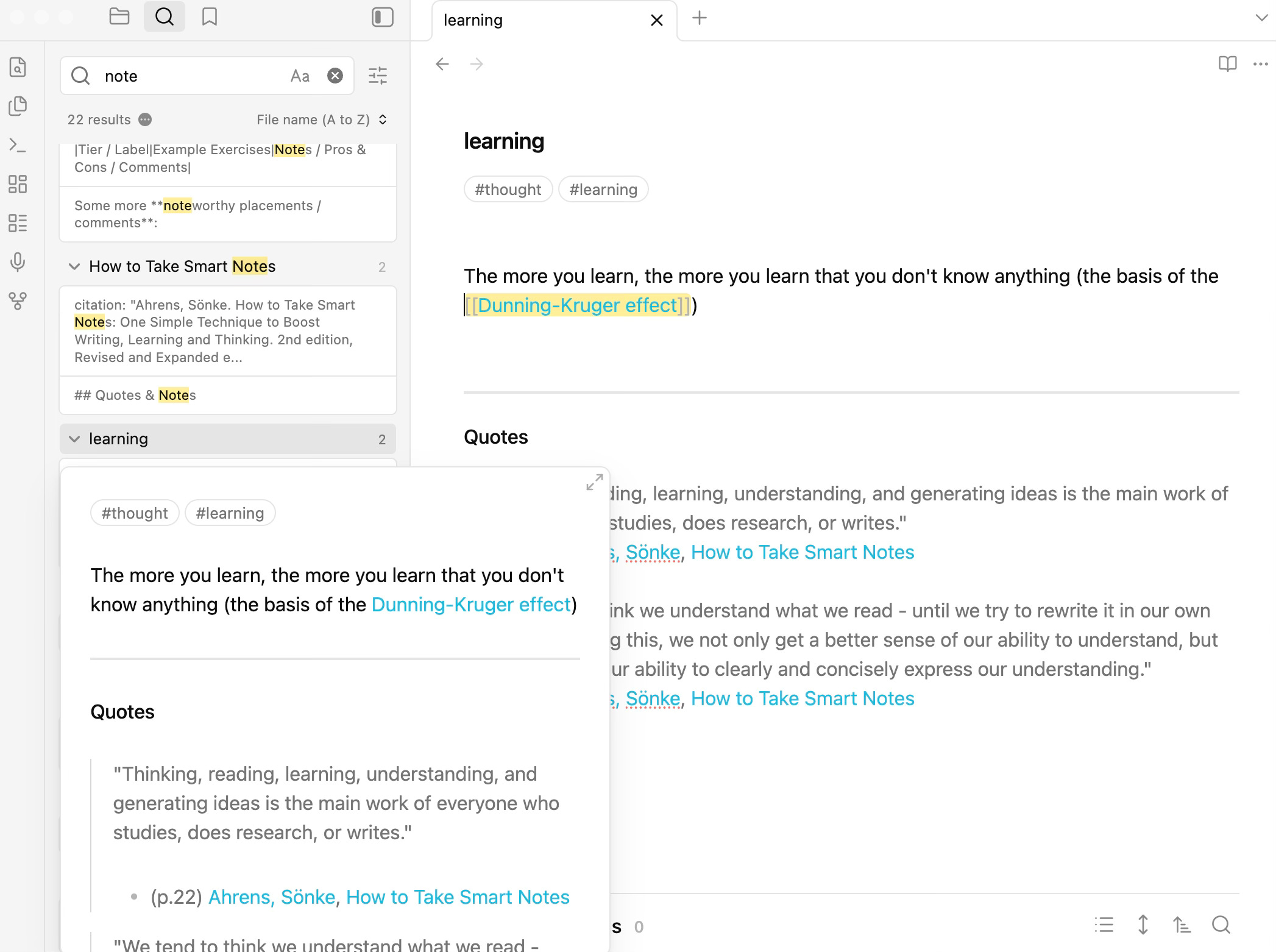
Writing is the central engine of learning. When you transform what you read or hear into your own words you turn passive exposure of information into durable understanding and reusable insight. You commit it to memory. You deepen your understanding, and you greatly increase the probability of drawing invaluable connections. This is the cycle the stimulates new ideas and discussions.
The Routine
The difference between writing papers now vs. in school is that no one is assigning it, there is no rubric, no deadline, and no grade.
That can feel intimidating at first, or possibly directionless. The truth is it is incredibly freeing. You get to decide the subject matter, the question, the scope, the source, and the audience. Shackles be gone!
Step 1: Choose a question within your topic
Choosing a broad topic will toss you right down the rabbit hole, Alice. If you choose to embark on researching a topic alone, you will likely skim the surface or drown completely. Neither of which produce any meaningful learning.
So, I trade “topic” for “question”. It should have a few defining qualities:
It’s specific, arguable, and actually matters to you.
For example, instead of researching “social media,” try:
“How is social media changing my ability to focus on deep work?”
“Why does short form content feel draining to me personally?”
“What are the behavioral effects of social media on teenagers?”
I don’t know, just spit-ballin. Notice how the questions are more narrow, and provide a more direct pathway to begin your work. The target is more clear and concise and will prevent you from overwhelm and inevitable “yeet” of the assignment altogether.
Write down a few contenders, and then choose the most that feels most alive in your body. (Weird? Maybe. But stick with me.)
You want a question that makes you curious, maybe a little annoyed, passionate, or even a little obsessive. Those are worth your time.
This is now the seed of your paper.
Step 2: Establish the Baseline
This is a habit I plucked from my middle school self, that I find to be the most telling. Before doing any reading, watching, listening, etc., I spend a couple minutes brain dumping everything I currently “know” about the subject matter. I also do this activity before I start a business project, including what do I know about the market I am building for, the industry itself, what do I know about the product, etc.
This little exercise is so much fun and for me, always very humbling. I realize quickly that I do not know shit. They are usually embarrassingly short, and met with an audible, “yikes” before saving in a buried folder that I pray is never unearthed.
Every once in a while I get a topic/research question that I know a considerable amount about and reveals where my strengths and expertise lie.
Save these - you will return to them at the end of the process to compare and pat yourself on the back.
